
Training Within Industry (TWI): Definition, Method and Principles
Definition, method and industrial applications: everything you need to know about Training Within Industry (TWI).
Definition, method and industrial applications: everything you need to know in 4 minutes.
Training Within Industry (TWI) is a structured program designed to provide supervisors with simple methods to train people on the job, improve work methods and better manage relationships within teams.
1. What are the origins of Training Within Industry?
It is 1941, and the United States is entering the war. Manpower and the industrial workforce are progressively mobilized. The context is one of an extreme need for mass production: millions of rifles, aircraft and military vehicles have to be manufactured urgently.
Between late 1941 and 1945, the United States achieved an unprecedented industrial feat: training 11 million people for wartime industrial jobs in less than four years.
Although this need to ramp up production may sound very similar to the challenges faced by manufacturers today, we are still talking about the 1940s.
This achievement relied on Training Within Industry (TWI), a program developed by four experts known as the “Four Horsemen”: Channing R. Dooley, together with Walter Dietz, M. J. Kane and William Conover.
TWI provided a methodological response, structuring training around three elements: the what (Important Steps), the how (Key Points), and the why (Reasons Why).
After the war, the program was introduced in around sixty countries as part of post-war reconstruction efforts, notably in Japan and at Toyota. It would significantly influence the development of the Toyota Production System under Taiichi Ohno. He applied TWI with rigor and discipline, while also improving it. This contributed to the philosophy reflected in Toyota’s mantra: “We build people before we build cars.”
TWI was also introduced in France, including in the wine industry, at Michelin and in the Alsace potash mines, under the acronym EMC, Entraînement au Métier de Chef.
2. What principles is the TWI method based on?
Training Within Industry was historically built around three main programs: Job Instruction, Job Methods and Job Relations.
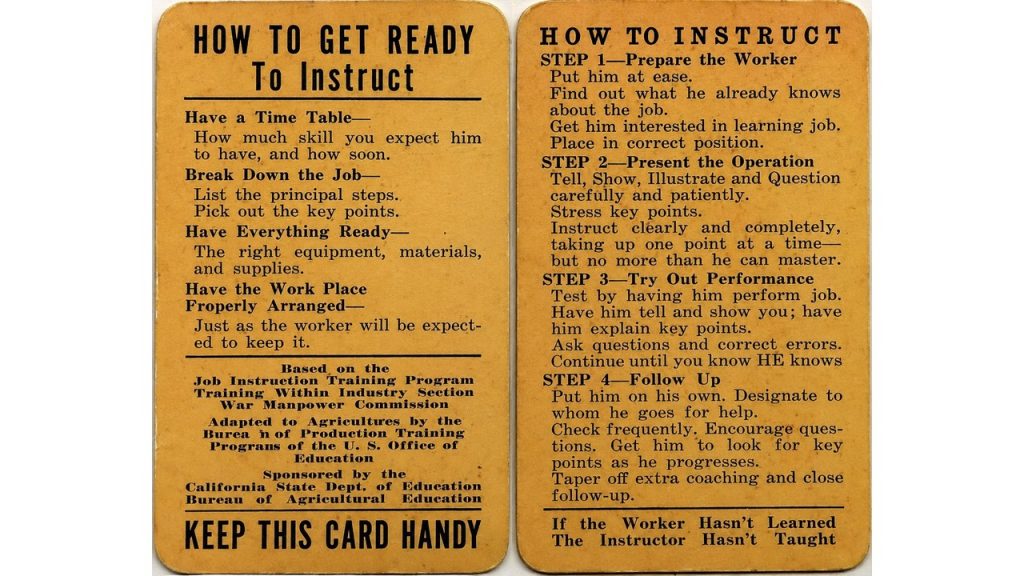
Job Instruction (JI): training someone to perform a job correctly
Why? To transfer know-how quickly to someone who has not yet mastered it.
How the method is structured:
- Present the job and break the know-how down into Important Steps, Key Points and Reasons Why: the what, the how and the why.
- An expert demonstrates the task, then the learner performs it and explains what they are doing.
- Correct, repeat and support the learner until they reach autonomy.
The objective is to make job performance reliable and repeatable.
Job Methods (JM): improving the way work is done
Why? To respond to a massive increase in production requirements using the resources already available.
How the method is structured:
- Analyse an existing operation step by step.
- Question each action in order to eliminate, combine, rearrange or simplify it.
- Test and then implement a more effective method.
The objective is to improve work methods in order to increase efficiency.
Job Relations (JR): creating a stable working environment
Why? Because human and interpersonal issues can directly affect production.
How the method is structured:
- Gather the facts, listen and analyse the situation when interpersonal or people-related issues arise.
- Decide on and take appropriate action, then check the results.
- Prevent tensions through information, recognition and involvement.
The objective is to maintain cooperation, motivation and performance..
3. TWI today: still relevant or no longer effective?
A proven method that remains relevant…
TWI remains relevant because it addresses an issue that is still central to industry: how to make someone operational at a workstation quickly, without compromising quality, safety or productivity.
Many industrial companies today face comparable constraints: the need to train people quickly, skills shortages, maintaining quality, transferring critical know-how, retirements, ramp-up requirements and more.
In this context, TWI provides a structured response. It enables companies to move from informal knowledge transfer, which may vary from one person to another, towards a more explicit and reliable form of transfer.
…But traditional TWI alone is no longer enough.
TWI provides a solid foundation, but its implementation also reveals certain limitations when considered against today’s industrial challenges and environments:
- Preserving, archiving and capitalizing on critical know-how.
- Reducing reliance on certain experts in order to free up some of their working time and prepare for anticipated departures.
- Adapting the method to the complexity and variety of tasks performed at the same workstation.
- Integrating digitalization and new ways of learning and consuming content among new generations, including digital, multimedia and on-demand formats.
- Addressing the growing importance of inclusion and accessibility, including multilingual content and text-to-speech.
Capitalizing on this know-how and making it accessible at scale, over time and independently of the trainer’s availability: this is where the discussion around modern industrial knowledge transfer, or TWI 2.0, begins.
From the blog to a pilot.
Do these challenges resonate with you? Start a pilot focused on one of your critical areas of know-how.